Learning Goal:
To help you critically reflect on your business idea using the three core pillars of a sustainable business model—Desirability, Viability, and Feasibility—as defined in Trampoline’s entrepreneurship framework.
Why This Matters
Many businesses start with a product idea. But unless that idea is desirable, financially sustainable, and deliverable, it will struggle to succeed—no matter how much passion is behind it.
By understanding the core of your business model, you lay the foundation for ethical, community-centred, and economically viable enterprise.
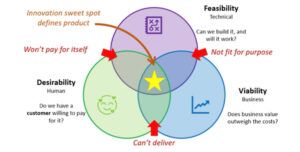
The 3 Pillars of a Business Model
1. Desirability: Do people want what you’re offering?
Your product must solve a real problem, meet a specific need, or bring joy to your audience.
Example: You make plant-based skincare products. Desirability exists if:
Reflective Question: What feedback or demand has shown that your idea matters to someone else—not just to you?
2. Viability: Can it support you financially?
Viability is about whether your business can make more money than it spends. It also includes thinking about long-term sustainability and growth.
Example: You sell your skincare cream for £12. Your production cost is £6 (including packaging, time, and marketing). You make £6 profit per unit. But you also must sell enough volume to cover fixed costs like website hosting and market stall fees.
Reflective Question: Can your pricing model and customer base support a real livelihood?
3. Feasibility: Can you deliver consistently?
Even if you have a desirable product and a viable pricing model, you still need the tools, people, and systems to deliver the service. This might be expertise, access to resources or your infrastructure and processes.
Example: You need:
If you get a large order tomorrow, can you fulfil it? If not, what’s your plan to scale?
Bonus Prompt: Your “Idea in One Sentence”
Use this formula to write your model in a single line:
“I offer [product/service] that helps [my audience] solve [problems], in a way that is sustainable and scalable.”
Example:
I offer handmade solid shampoo bars that help eco-conscious families reduce plastic use, using natural ingredients and zero-waste packaging.
Wrap-up Reflection
“If it’s not desirable, people won’t care.
If it’s not viable, you won’t survive.
If it’s not feasible, you won’t deliver.”
This capsule prepares you to move from idea to action—rooted in customer needs and supported by realistic planning.
Activity: The Business Model Snapshot
Estimated time: 30 minutes
For your business try to answer the following questions. Make sure your responses are not vague:
Desirability
Viability
Feasibility
What would you need to do to scale?